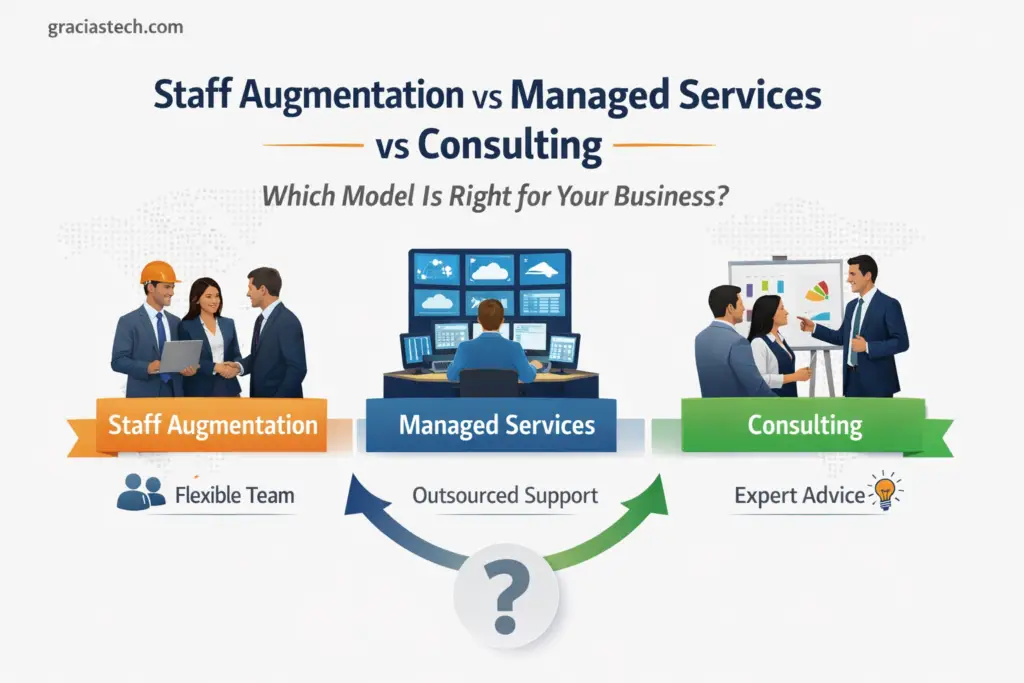
When businesses need external tech support, they’re often overwhelmed by three options: staff augmentation, managed services, and consulting. Each model sounds similar on the surface — but picking the wrong one can cost you time, money, and control over your product. This guide breaks down exactly how these three engagement models differ, when to use each, and how to make the right call for your business in 2026.
What Is Staff Augmentation?
Staff augmentation is a flexible hiring model where you bring in external developers or specialists who work directly under your management, embedded within your existing team. These professionals follow your workflows, use your tools, and report to your leads — just like an in-house employee, without the overhead of full-time hiring.
This model is particularly powerful when you have an active, ongoing project and need to scale your technical capacity fast — whether that’s a senior React developer, a DevOps engineer, or a cloud architect.
Key Traits of Staff Augmentation
- You retain full control over tasks, timelines, and delivery
- Augmented staff integrate directly into your team culture and tools
- Pricing is typically hourly or monthly — transparent and predictable
- Scales up or down based on workload with minimal friction
- Best for evolving projects with changing requirements
Best for: Companies with in-house tech leadership that need to fill skill gaps quickly or expand capacity without long-term hiring commitments.
What Are Managed Services?
Managed services involve outsourcing the ongoing responsibility of a specific function — such as cloud infrastructure, cybersecurity, or application maintenance — to a third-party provider. Unlike staff augmentation, you’re not managing individual people. You’re purchasing an outcome or SLA (Service Level Agreement).
The managed service provider (MSP) owns the process, the team, and the tools. They handle everything under the hood. Your job is simply to define expectations and hold them accountable to agreed benchmarks.
Key Traits of Managed Services
- Vendor owns execution, staffing, and delivery
- You get measurable outcomes tied to SLAs, not individual contributors
- Pricing is typically subscription-based or retainer-based
- Less day-to-day involvement required from your side
- Ideal for repetitive, operational, or infrastructure-heavy functions
Best for: Businesses that want to offload routine operations — like cloud monitoring, network management, or IT helpdesk — without building internal expertise.
What Is IT Consulting?
IT consulting is a knowledge-transfer and strategy model. Consultants don’t build your product or manage your infrastructure — they advise on architecture, technology choices, digital transformation roadmaps, or organizational structure. The deliverable is insight and recommendations, not code or operations.
Consulting engagements are typically short-term and project-scoped, concluding with a report, strategy document, audit, or technology blueprint your internal team then executes.
Key Traits of IT Consulting
- Engagement is advisory — not hands-on implementation
- Time-bound projects: assessments, audits, roadmaps, architecture reviews
- Pricing is often project-based or daily consulting rates
- High expertise, narrow scope
- Requires your team to implement recommendations after the engagement
Best for: Organizations at a crossroads — evaluating a new tech stack, planning a cloud migration, or needing an independent audit before a major investment.
Staff Augmentation vs Managed Services vs Consulting: Side-by-Side
| Factor | Staff Augmentation | Managed Services | Consulting |
|---|---|---|---|
| Control | Full (you manage) | Low (vendor manages) | Advisory only |
| Deliverable | Code / features | Operational outcomes | Strategy / roadmap |
| Pricing Model | Hourly / monthly | Subscription / retainer | Project / daily rate |
| Duration | Ongoing / flexible | Long-term contract | Short-term / defined |
| Team Integration | Fully embedded | Separate vendor team | External advisor |
| Risk Ownership | Shared | Mostly vendor | Client-side |
| Best Use Case | Scale dev capacity | Offload operations | Strategic decisions |
Key Differences Explained in Depth
1. Control vs. Delegation
This is the most fundamental distinction. With staff augmentation, you’re in the driver’s seat — you assign tasks, review code, and make product decisions. With managed services, you delegate an entire function to an external provider and hold them accountable via SLAs. With consulting, you receive expert guidance but remain fully responsible for implementation.
If your engineering leadership is strong and you know what needs to be built, staff augmentation gives you the best leverage. If your team lacks bandwidth to manage operations, managed services make sense. If you’re unsure what to build or how to architect it, consultants provide the clarity you need first.
2. Cost Transparency and Predictability
Staff augmentation offers the most cost transparency — you pay for the hours or months your augmented staff works, with no surprises. Managed services come with flat monthly pricing, which is predictable but can include tiered fees or penalties if SLAs are breached. Consulting is often the most expensive per hour, but engagements are typically short, making total spend manageable.
Hidden costs tend to surface most in managed services contracts when scope creep occurs or when businesses need to renegotiate terms as requirements evolve.
3. Flexibility and Scalability
Staff augmentation is the most flexible model — you can scale a team up during a product launch sprint and scale down post-release. Managed services contracts are usually rigid, designed for long-term stability rather than rapid change. Consulting engagements are short by design but lack flexibility in scope once the statement of work is signed.
4. Knowledge Retention
A major advantage of staff augmentation is that your product knowledge stays inside your organization. Augmented staff work within your codebase and documentation every day. With managed services and consulting, institutional knowledge can reside with the vendor — creating dependency risks when contracts end or providers change.
How to Choose the Right Model for Your Business
Here’s a simple decision framework:
- Choose Staff Augmentation if you have internal tech leadership, an active product roadmap, and need skilled developers to execute faster.
- Choose Managed Services if you want to offload routine IT operations — like cloud monitoring, security, or helpdesk — and prefer outcome-based accountability.
- Choose Consulting if you’re making a major strategic or architectural decision and need an expert opinion before committing resources.
Many growing businesses use all three models at different stages. A startup might hire a consultant to define their cloud architecture, use staff augmentation to build the product, and eventually transition routine maintenance to a managed service provider as the product matures.
Why Staff Augmentation Is the Preferred Choice for Software Development Teams
For software companies and product teams specifically, staff augmentation consistently outperforms the alternatives when it comes to velocity, quality, and control. Here’s why:
- Direct access to specialized talent: Need a senior cloud architect with AWS expertise or a mobile developer with Flutter experience? Staff augmentation lets you find and onboard that exact profile in days, not months.
- Agile-friendly: Augmented developers integrate directly into your Scrum sprints, stand-ups, and Jira boards. Managed service providers and consultants rarely operate at this level of granularity.
- IP protection: Your code, your architecture, your product — everything stays within your team’s ecosystem rather than being exposed to vendor systems.
- No vendor lock-in: Unlike managed services contracts that can be difficult to exit, staff augmentation agreements are typically month-to-month or milestone-based.
At GraciasTech, we specialize in connecting software teams with pre-vetted engineers in cloud computing, full-stack development, AI/ML, and DevOps — so you get the right talent at the right time, working exactly the way your team needs.
Frequently Asked Questions (FAQs)
Not sure which model fits your business?
Talk to the GraciasTech team for a free consultation — we’ll help you evaluate the right engagement model for your product, team, and growth stage.