
Introduction
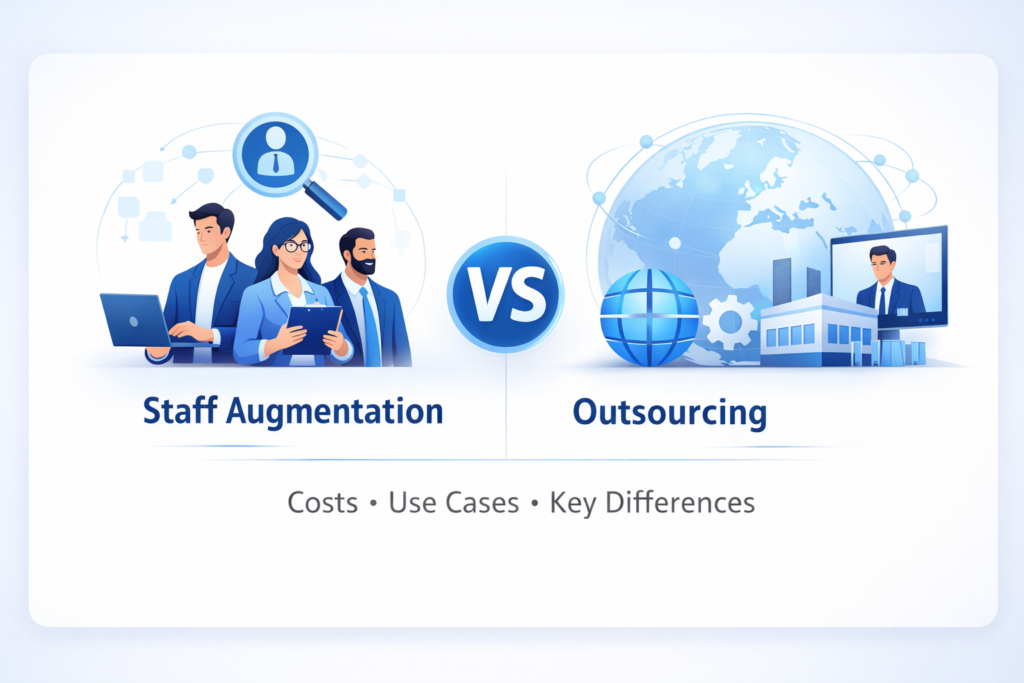
Choosing the right engagement model can directly impact your product speed, cost control, and long-term scalability. Two commonly used models staff augmentation VS outsourcing—are often confused, despite serving very different business needs.
This guide breaks down the core differences between staff augmentation and outsourcing, helping you decide which model aligns best with your project goals, budget, and level of control.
What Is Staff Augmentation?
Staff augmentation is a hiring model where external developers or specialists join your existing in-house team. These professionals work under your management, follow your processes, and integrate directly into your workflow.
Key Characteristics of Staff Augmentation
- You manage tasks, priorities, and delivery
- Developers work as part of your internal team
- Flexible scaling up or down
- Ideal for evolving or long-term projects
Staff augmentation is best when you need speed, control, and skill-specific expertise without long-term hiring commitments.
What Is Outsourcing?
Outsourcing involves hiring a third-party vendor to fully manage and deliver a project or function. The vendor is responsible for execution, timelines, and outcomes based on predefined requirements.
Key Characteristics of Outsourcing
- Vendor manages the team and delivery
- Limited involvement in daily operations
- Fixed or milestone-based pricing
- Best for clearly defined, standalone projects
Outsourcing works when requirements are stable and you prefer hands-off execution.
Staff Augmentation vs Outsourcing: Side-by-Side Comparison
| Factor | Staff Augmentation | Outsourcing |
|---|---|---|
| Management Control | Full control | Limited control |
| Team Integration | Fully integrated | Separate team |
| Pricing Model | Hourly / monthly | Fixed or milestone |
| Flexibility | High | Low |
| Project Scope | Evolving | Fixed |
| Risk Ownership | Shared | Mostly vendor |
| Best For | Agile development | Fixed-scope projects |
Key Differences Explained
1. Control and Transparency
With staff augmentation, you control architecture, code quality, and timelines. Outsourcing transfers execution responsibility to the vendor, reducing visibility into daily progress.
2. Cost Structure and Hidden Expenses
Staff augmentation offers predictable hourly costs with no vendor lock-in. Outsourcing may appear cheaper initially but often includes hidden costs such as change requests, scope revisions, and rework.
3. Flexibility and Scalability
Staff augmentation allows you to scale teams instantly based on workload. Outsourcing is less flexible once contracts and scopes are finalized.
4. Knowledge Retention and IP Security
Augmented staff work inside your ecosystem, keeping product knowledge internal. Outsourcing risks knowledge silos and dependency on vendors.
Final Verdict: Which Model Is Right for You?
There is no universal winner.
- If you value control, flexibility, and long-term scalability, staff augmentation is the better choice.
- If you want hands-off delivery with fixed scope, outsourcing makes sense.
The right decision depends on how much control you’re willing to give up—and how much risk you’re prepared to manage.
Frequently Asked Questions (FAQs)
Need help choosing the right engagement model?
Talk to our experts at GraciasTech to evaluate the best approach for your product and team.